



Should I refinance student loans or pursue PSLF as a lawyer?
For over 15 years in the intricate world of debt management, especially within the high-stakes environment of legal professionals, I've witnessed firsthand the paralyzing dilemma many lawyers face: the monumental burden of student loan debt. It's a weight that can dictate career paths, delay major life milestones, and cast a long shadow over financial well-being.
The core of this struggle lies in a critical fork in the road: Do you chase the promise of Public Service Loan Forgiveness (PSLF), dedicating years to public service, or do you seek the immediate relief and potentially lower interest rates offered by refinancing? This isn't just a financial calculation; it's a profound life decision, fraught with complexities and often, misinformation.
In this definitive guide, I will cut through the noise, offering you a clear, expert-driven framework to navigate this choice. We'll delve into the nuances of PSLF eligibility, the true cost-benefit of refinancing, and equip you with actionable strategies, real-world case studies, and the insights you need to make the most informed decision for your unique legal career and financial future.
Understanding Public Service Loan Forgiveness (PSLF): The Golden Ticket (or so it seems)
Public Service Loan Forgiveness (PSLF) is often seen as the holy grail for lawyers burdened by substantial student debt, especially those committed to public service. In essence, it promises forgiveness of your remaining federal student loan balance after you've made 120 qualifying monthly payments while working full-time for a qualifying employer.
However, the path to PSLF is paved with strict requirements and, historically, a significant amount of confusion. To qualify, you must have Direct Loans (or consolidate other federal loans into Direct Loans), be enrolled in an Income-Driven Repayment (IDR) plan, and work for an eligible government entity or 501(c)(3) non-profit organization. Every single one of these criteria carries specific definitions and potential pitfalls.
Expert Insight: PSLF is not a 'set it and forget it' program. Regular verification of employment and diligent tracking of payments are absolutely critical. I've seen too many promising candidates fall short due to administrative errors or misunderstandings of the rules.
Crucially, only federal student loans are eligible for PSLF. If you have private student loans, they will never qualify for this program. You can find the official rules and track your progress through the Federal Student Aid website: studentaid.gov/public-service.

The Allure of Refinancing: Lower Rates, Simpler Payments
On the other side of the coin is refinancing, a strategy that many lawyers consider for its promise of lower interest rates and potentially simpler monthly payments. When you refinance, a private lender pays off your existing student loans (federal or private) and issues you a new loan with new terms, including a new interest rate and repayment schedule.
The primary benefit here is often a lower interest rate, especially if you have excellent credit and a stable income. This can translate to significant savings over the life of the loan and a reduced monthly payment. Private lenders can offer fixed or variable interest rates, and you often have flexibility in choosing your loan term, ranging from 5 to 20 years.
However, this comes at a significant cost: by refinancing federal student loans with a private lender, you forfeit all federal benefits. This includes access to IDR plans, deferment and forbearance options, and, critically, eligibility for PSLF. It's a trade-off between potentially saving money on interest versus losing the safety net and forgiveness potential of federal programs.
As Forbes highlights in its financial guidance, understanding the fine print of private loan terms is paramount before committing: Forbes Advisor: Should You Refinance Student Loans?
The Critical Decision Framework: PSLF vs. Refinance for Lawyers
Making this choice requires more than just a quick glance at interest rates. It demands a structured, comprehensive framework that accounts for your career goals, financial situation, and risk tolerance.
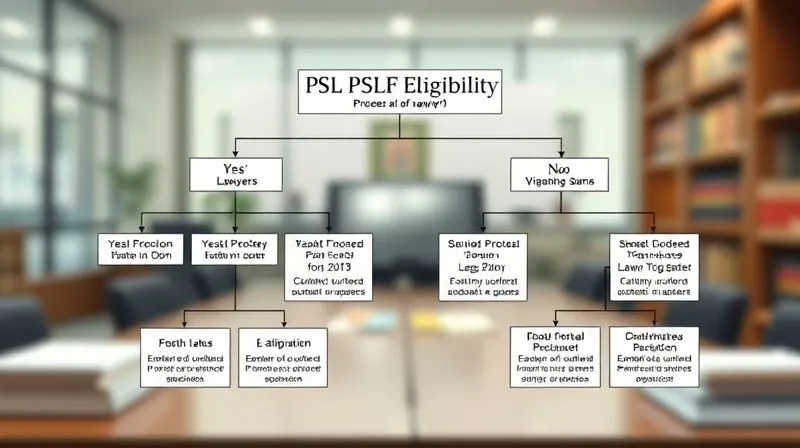
Step 1: Assess Your PSLF Eligibility and Commitment
Before anything else, you must rigorously evaluate if PSLF is even a viable option for you. This isn't just about your current job; it's about your career commitment.
- Employer Qualification: Is your current employer (or your target employer) a government organization (federal, state, local, tribal) or a 501(c)(3) non-profit? Double-check this with your HR department and the official PSLF rules.
- Employment Status: Are you working full-time (typically 30+ hours/week, or your employer's definition of full-time if it's at least 30 hours)?
- Loan Type: Do you have Federal Direct Loans? If not, can your loans be consolidated into Direct Loans? (Be aware that consolidation resets your payment count for PSLF, though temporarily, if you have prior qualifying payments under the IDR waiver).
- IDR Enrollment: Are you currently, or willing to be, enrolled in a qualifying Income-Driven Repayment (IDR) plan (PAYE, REPAYE, IBR, ICR)?
- Long-Term Commitment: Are you genuinely committed to remaining in public service for at least 10 years (120 payments)? This is perhaps the most significant non-financial factor.
Step 2: Calculate Your Potential PSLF Forgiveness Amount
If you've cleared Step 1, the next move is to estimate the potential forgiveness. This requires understanding your IDR payments.
IDR payments are typically a percentage of your discretionary income, which is the difference between your adjusted gross income (AGI) and 150% of the poverty guideline for your family size. Your payments could be as low as $0, but they will adjust annually based on your income and family size.
The core idea is that you make the lowest possible payments under IDR for 10 years, and the remaining balance is forgiven tax-free. Use the Federal Student Aid Loan Simulator tool to get a personalized estimate of your IDR payments and potential forgiveness amount. This is a crucial step in understanding the true financial benefit of PSLF.
Step 3: Evaluate Refinancing Savings vs. PSLF Forgiveness
Now, compare the two paths head-to-head. This is where the numbers game truly begins.
First, get quotes from several private lenders for refinancing. Understand the new interest rate, loan term, and total interest paid over the life of the refinanced loan. Then, compare this total cost (principal + interest) to the total payments you'd make under an IDR plan for 10 years, plus the amount that would be forgiven under PSLF.
| Factor | PSLF Consideration | Refinance Consideration |
|---|---|---|
| Loan Type Eligibility | Federal Direct Loans ONLY | Federal & Private Loans (becomes private) |
| Interest Rate Potential | No direct rate change, focus on IDR payments | Potentially lower rates based on credit/income |
| Payment Structure | Income-Driven Repayment (IDR) | Fixed monthly payment, often higher |
| Forgiveness Potential | Remaining balance after 120 payments (tax-free) | None |
| Federal Protections | Retained (IDR, deferment, forbearance) | Lost |
| Career Flexibility | Limited to qualifying public service for 10 years | Full flexibility, no employer restrictions |
| Total Cost Over Time | Sum of IDR payments over 10 years | Principal + total interest paid |
It's vital to consider the time value of money and the opportunity cost. If you save $50,000 through PSLF forgiveness but earn significantly less for 10 years in public service compared to what you could earn in the private sector, the net benefit needs careful calculation.
Step 4: Consider Your Career Trajectory and Risk Tolerance
Financial decisions are rarely purely mathematical. Your career aspirations and comfort with risk play a huge role.
Are you genuinely passionate about public service, or would staying in it for 10 years lead to burnout and dissatisfaction? What if your dream job in the private sector comes along in year 5 of PSLF? The commitment to public service for a decade is substantial. If you leave qualifying employment, even for a short period, you reset your PSLF clock (though there are some nuances with the IDR waiver). Refinancing, while losing forgiveness potential, offers unparalleled career flexibility.
Expert Insight: Your career satisfaction is a form of currency. Don't underestimate the psychological cost of being tied to a job solely for student loan forgiveness if it doesn't align with your true professional calling.
Case Study: Navigating the Debt Labyrinth – Attorney Sarah's Choice
Case Study: Attorney Sarah's Student Loan Decision
Sarah, a bright attorney, graduated with $180,000 in federal student loans at an average interest rate of 6.5%. She started her career as a public defender, earning $65,000 per year.
PSLF Path Analysis: Sarah enrolled in the PAYE (Pay As You Earn) IDR plan. Her initial monthly payment was around $300. Over 10 years, assuming her income grew modestly to $90,000, her total payments would be approximately $50,000. The remaining balance of roughly $130,000 would be forgiven tax-free. This path required her to stay in public service for 10 years.
Refinance Path Analysis: Sarah received an offer from a private firm in her third year of public service, with a starting salary of $120,000. She explored refinancing options. A private lender offered her a 4.0% fixed interest rate on a 15-year term. Her new monthly payment would be around $1,330, with total interest paid over 15 years amounting to approximately $60,000. Her total repayment would be $180,000 (principal) + $60,000 (interest) = $240,000.
Sarah's Decision: Despite the allure of PSLF, Sarah realized that the public defender role, while fulfilling, wasn't her long-term career goal. The offer from the private firm represented a significant leap in her career path and earning potential. She calculated that even with the $130,000 forgiveness, the cumulative difference in her income over 10 years (public vs. private) would far outweigh the PSLF benefit. The higher private salary allowed her to aggressively pay down the refinanced loan, aiming to pay it off in 7-8 years instead of 15. She chose to refinance, accepting the loss of federal benefits for greater career flexibility and higher earning potential, which she used to accelerate debt repayment.

The Intricacies of Income-Driven Repayment (IDR) Plans
For those pursuing PSLF, understanding Income-Driven Repayment (IDR) plans is not just important; it's absolutely fundamental. These plans are designed to make your monthly loan payments affordable based on your income and family size, capping them at a percentage of your discretionary income. The four main IDR plans are:
- Pay As You Earn (PAYE): Generally 10% of discretionary income, for up to 20 years.
- Revised Pay As You Earn (REPAYE): Generally 10% of discretionary income, for up to 20 or 25 years.
- Income-Based Repayment (IBR): Generally 10% or 15% of discretionary income, for up to 20 or 25 years.
- Income-Contingent Repayment (ICR): Generally 20% of discretionary income or what you'd pay on a fixed 12-year plan, whichever is less, for up to 25 years.
Your choice of IDR plan can significantly impact your monthly payment, and thus, the amount of debt that remains for forgiveness under PSLF. Lower payments mean more will be forgiven. However, lower payments also mean you'll pay more interest over time if you don't receive forgiveness. This is why the PSLF calculation is so critical.
For a detailed breakdown of each plan and how they might affect you, an excellent resource is The Student Loan Planner's comprehensive guide to IDR plans: Student Loan Planner: IDR Plans Explained.
When Refinancing Makes Sense: The Lawyer Who Opts Out of PSLF
While PSLF holds significant appeal, it's not the right choice for every lawyer. There are specific scenarios where refinancing federal student loans, despite losing federal benefits, can be the superior financial decision.
Refinancing often makes sense if:
- You're in the Private Sector: If your career path is firmly rooted in private practice, where PSLF-qualifying employment is not an option, then holding onto federal loans with higher interest rates (if applicable) and hoping for forgiveness is a non-starter. Refinancing offers a direct path to reducing interest costs.
- Your Income is High: If your income is substantial and projected to grow rapidly, your IDR payments might be very high, leaving little to no balance for PSLF forgiveness. In such cases, the benefit of PSLF diminishes, and a lower interest rate from refinancing becomes more attractive.
- You Have Manageable Debt: If your student loan debt is relatively low compared to your income, the administrative burden and career constraints of PSLF might not be worth the potential forgiveness. Refinancing for a better rate could be a simpler, more efficient strategy.
- You Have Excellent Credit: Private lenders offer their best rates to borrowers with strong credit scores. If you have a high credit score and a stable income, you're in a prime position to secure a significantly lower interest rate through refinancing.
- You Prioritize Simplicity and Control: Some individuals prefer the straightforward nature of a single private loan with a fixed payment and a clear payoff date, rather than the annual recertification and complex rules of IDR and PSLF.
In these situations, the benefits of a lower interest rate, simplified payments, and freedom from public service constraints often outweigh the lost federal protections and PSLF eligibility.
Hybrid Strategies: A Niche Approach?
Can you have your cake and eat it too? Sometimes, a hybrid approach might be considered, though it requires careful planning and a deep understanding of your loans.
The most common hybrid strategy involves separating your loans. If you have both federal and private student loans, you could choose to refinance only your private loans to potentially get a lower interest rate, while keeping your federal loans to pursue PSLF. This allows you to optimize both types of debt without jeopardizing your PSLF eligibility for the federal portion.
Another, more complex scenario, might involve refinancing a portion of your federal loans that you know will never qualify for PSLF (e.g., if you only have a small amount of federal debt and your income is too high for meaningful IDR payments). However, this is generally not recommended as it complicates your debt portfolio and could lead to errors.
My advice: for most lawyers, a clear choice between PSLF or full refinancing of federal loans is usually the safest and most straightforward path. Hybrid strategies introduce additional complexity and potential for missteps, which can be costly.
Beyond the Numbers: Psychological and Lifestyle Factors
While we've focused heavily on the financial mechanics, it's crucial not to overlook the profound psychological and lifestyle impacts of your student loan decision. Debt, especially substantial student loan debt, can be a heavy mental burden.
The pursuit of PSLF, while financially rewarding in the long run, can mean a decade of lower income, potentially limiting your ability to save for a down payment, invest, or start a family. It also binds you to specific employment, which might feel restrictive if your career interests evolve. The psychological freedom that comes with either having a clear path to forgiveness or aggressively paying down a refinanced loan can be immense.
Conversely, refinancing offers flexibility but places the full burden of repayment squarely on your shoulders, without a forgiveness safety net. Consider which scenario aligns better with your personal values, long-term happiness, and tolerance for financial stress. Your mental well-being is an invaluable asset that shouldn't be overlooked in this equation.

Frequently Asked Questions (FAQ)
Question: What if my public service job doesn't qualify for PSLF? Detailed answer: This is a common pitfall. Before committing to a job for PSLF, ensure your employer is a government organization or a 501(c)(3) non-profit. Always submit an Employment Certification Form (ECF) annually, or whenever you change employers, to confirm your eligibility. If your job doesn't qualify, those payments won't count, and you'll need to re-evaluate your strategy, potentially switching to a qualifying employer or considering refinancing.
Question: Can I refinance some federal loans and keep others for PSLF? Detailed answer: Yes, technically you can. If you have multiple federal loans, you could choose to refinance only a portion of them with a private lender, while keeping the remaining federal loans eligible for PSLF. However, this adds complexity to your financial management. It's generally only advisable if you have a very clear reason, such as some federal loans having extremely high interest rates that you want to target specifically, or if you have a mix of Direct Loans and older federal loans that would require consolidation to qualify for PSLF, and you only want to consolidate certain ones. For most, a unified strategy is simpler.
Question: What's the biggest risk with PSLF? Detailed answer: The biggest risk with PSLF is often the uncertainty and the long-term commitment. Rules can change (though recent waivers have helped), administrative errors can occur, and your career path might diverge from public service. The risk lies in making 120 payments only to find you don't qualify or that your commitment wanes. This is why consistent verification and a genuine commitment to public service are paramount.
Question: How do I calculate my potential PSLF forgiveness? Detailed answer: There isn't a single, simple formula, as it depends on your specific IDR plan, your income, family size, and how those factors change over 10 years. The best way is to use the Federal Student Aid Loan Simulator tool (studentaid.gov/loan-simulator). Input your actual loan details, income, and family size, and it will project your payments and potential forgiveness under various IDR plans.
Question: Does my income affect PSLF? Detailed answer: Yes, absolutely. Your income directly affects your monthly payment amount under an Income-Driven Repayment (IDR) plan. Lower income generally means lower monthly payments, which means more of your original loan balance will remain to be forgiven after 120 payments. Conversely, higher income means higher IDR payments, reducing the amount that will ultimately be forgiven.
Key Takeaways and Final Thoughts
Navigating the choice between PSLF and refinancing is one of the most significant financial decisions a lawyer will make. It's a complex interplay of current financial standing, future career aspirations, and personal risk tolerance. Here are the critical takeaways:
- PSLF is for the Committed: It requires a steadfast, 10-year commitment to qualifying public service and meticulous adherence to federal program rules.
- Refinancing is for Flexibility & Lower Rates: It offers potential interest savings and career freedom, but at the cost of all federal protections and forgiveness options.
- Run the Numbers Rigorously: Use online simulators and gather refinance quotes. Don't guess; calculate your potential savings or forgiveness.
- Consider Your Career Path: Your professional satisfaction and long-term goals are as important as the financial figures. Don't underestimate the value of career flexibility.
- Verify, Verify, Verify: If pursuing PSLF, confirm employer eligibility and submit Employment Certification Forms regularly.
Ultimately, there's no universally 'correct' answer to whether you should refinance student loans or pursue PSLF as a lawyer. Your optimal path is deeply personal and hinges on your unique circumstances. By applying this expert framework, asking the right questions, and being honest about your career and financial aspirations, you can make a confident, informed decision that paves the way for a more secure and satisfying future. Don't let indecision be your biggest debt; take control and chart your course today.
Recommended Reading
- Unmasking the Code: How to Avoid Smart Contract Vulnerabilities Now
- Unlock True Value: 7 Steps to Accurately Value Distressed Commercial Property
- Unlock Growth: 7 Steps to Secure Grants for Employee Development
- Unlock Your Dream Home: How to Get Financing for an Auctioned Foreclosed Home
- Unlock Financial Freedom: How to Manage Debt While Building an Emergency Fund





Comments
Leave a comment below. Your email will not be published. Required fields marked with *