



How to choose optimal commercial deductibles to improve cash flow?
For over 20 years in the commercial insurance sector, specifically guiding businesses through the complexities of risk management and financial optimization at insurancehelm.com, I've witnessed firsthand how a seemingly minor decision – the choice of your commercial deductible – can profoundly impact a company's financial health. I’ve seen thriving businesses unintentionally stifle their growth due to inefficient insurance structures, and conversely, I've helped struggling enterprises find new breathing room by simply aligning their deductibles with their true financial capacity and risk appetite.
Many business owners view insurance as a necessary evil, a fixed cost to be minimized at all costs, often without fully understanding the strategic levers available to them. The common pain point is a constant tug-of-war between high premiums draining operational cash and the fear of crippling out-of-pocket expenses if a large claim occurs. This dilemma often leads to suboptimal choices that either unnecessarily tie up capital or expose the business to unacceptable risks, directly hindering cash flow.
This article isn't just about reducing your insurance bill; it’s about empowering you to make informed, strategic decisions that enhance your business's financial resilience and operational liquidity. I'll walk you through actionable frameworks, real-world case studies, and expert insights to help you navigate the nuances of commercial deductibles, ensuring your insurance strategy actively contributes to a healthier, more predictable cash flow.
Understanding the Deductible Landscape: More Than Just a Number
Before we dive into optimization, let's ensure we're all speaking the same language. A deductible isn't just an arbitrary number on your policy; it's a critical component of your risk transfer strategy.
What is a Commercial Deductible?
Simply put, a commercial deductible is the amount of money your business must pay out-of-pocket before your insurance coverage kicks in to cover the remaining costs of a covered loss. It's the policyholder's initial share of a claim. For example, if you have a $5,000 deductible and a $20,000 covered loss, you pay the first $5,000, and your insurer pays the remaining $15,000.
Types of Deductibles and Their Implications
Commercial policies can feature various deductible structures, each with distinct implications for your cash flow and risk exposure:
- Per-Occurrence Deductible: This is the most common type, applying to each individual claim or occurrence. If you have multiple separate claims within a policy period, you'll pay the deductible for each.
- Annual Aggregate Deductible: With this structure, you pay a deductible for each claim until a predetermined annual maximum (the aggregate limit) is reached. Once that aggregate is met, the insurer pays 100% of subsequent covered losses for the remainder of the policy term, without further deductibles. This can offer significant cash flow predictability for businesses with frequent, smaller claims.
- Waiting Period Deductible: Often seen in business interruption or disability policies, this isn't a monetary amount but a period of time that must pass after a loss event before benefits begin.
- Percentage Deductible: Less common but sometimes used for specific perils (e.g., windstorm, earthquake), where the deductible is a percentage of the insured property's value or the total loss, rather than a fixed dollar amount. This can lead to very high deductibles for substantial losses.
Expert Insight: "A deductible isn't merely a cost; it's a strategic lever. Viewing it in isolation misses the bigger picture of risk retention, premium savings, and ultimately, your business's financial agility."
The Direct Link: Deductibles, Premiums, and Your Cash Flow
The relationship between your deductible and your insurance premium is fundamental: they typically move in inverse directions. A higher deductible generally leads to a lower premium, and vice versa. This dynamic is the core of how to choose optimal commercial deductibles to improve cash flow.
When you opt for a higher deductible, you're essentially telling the insurer that your business is willing to retain more of the initial risk. From the insurer's perspective, this means they'll pay out less frequently for smaller claims, and their exposure to larger claims is reduced by your larger initial contribution. This decreased risk to the insurer translates into a lower premium for you, freeing up immediate cash that would otherwise be tied up in monthly or annual payments.
However, this cash flow improvement isn't without its caveats. While a lower premium boosts your operational cash, a higher deductible means your business must be prepared to absorb a larger out-of-pocket expense should a claim occur. This requires careful consideration of your business's financial capacity and risk tolerance. The goal is to find that 'sweet spot' where premium savings significantly outweigh the manageable increase in potential out-of-pocket costs, ensuring a net positive impact on your overall cash flow without exposing your business to undue financial strain.

Step-by-Step: Assessing Your Business's Risk Appetite and Financial Health
Choosing the right deductible isn't a guessing game; it's a calculated decision rooted in understanding your business's unique risk profile and financial capabilities. Here's a systematic approach I guide my clients through:
Step 1: Analyze Your Claim History (The Past Predicts the Future)
Review your past 3-5 years of insurance claims. Ask yourself:
- Frequency: How often do you file claims? Are they numerous small claims or infrequent large ones?
- Severity: What's the average cost of your claims? What's the maximum cost you've incurred?
- Patterns: Are there recurring types of claims? This might indicate areas where loss prevention could be improved.
A business with a history of many small, predictable claims might benefit from a higher deductible to reduce premiums, as they're likely to pay those smaller amounts anyway. Conversely, a business with very few claims might prefer a lower deductible if they lack the cash reserves for a large, unexpected outlay.
Step 2: Evaluate Your Current Cash Reserves and Liquidity
Honestly assess how much cash your business can comfortably afford to pay out-of-pocket in the event of a claim without disrupting operations. This isn't about what you *could* pay, but what you *can* pay without significant financial stress. Consider:
- Your emergency fund size.
- Your working capital.
- Your access to lines of credit.
A healthy cash reserve empowers you to absorb higher deductibles, unlocking greater premium savings.
Step 3: Understand Your Industry's Risk Profile
Every industry carries inherent risks. A construction company faces different liabilities than a retail store or a consulting firm. Research industry benchmarks for claims frequency and severity. Are you in a high-risk sector prone to frequent, costly incidents? Or a relatively stable one where claims are rare?
Step 4: Project Potential Future Losses
Beyond historical data, consider future exposures. Are you expanding into new markets, launching new products, or taking on new operational risks? These changes can alter your risk profile and, consequently, your optimal deductible level.

Expert Insight: "The most effective deductible strategies are built on data, not gut feelings. Use your past to inform your future, but always keep an eye on evolving risks."
Leveraging Data: Forecasting Impact with Financial Modeling
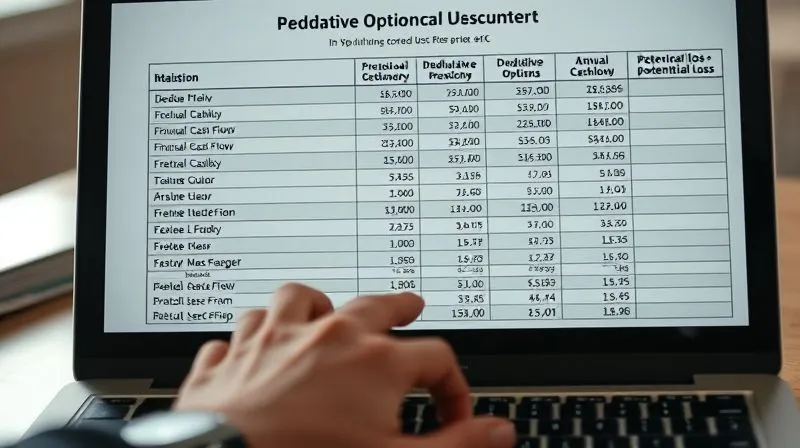
Once you've assessed your risk appetite, the next step is to quantify the potential impact of different deductible choices on your cash flow. This is where a simple financial model becomes invaluable. You don't need to be a financial wizard; even a basic spreadsheet can provide profound clarity.
Building a Simple Deductible Impact Model
Here’s how you can approach it:
- List Deductible Options: Start with your current deductible and explore higher alternatives (e.g., $1,000, $5,000, $10,000, $25,000).
- Obtain Premium Quotes: Get quotes from your insurer or broker for each deductible option.
- Estimate Claim Frequency and Severity: Based on your historical data (Step 1), project the likely number of claims you expect in a year and their average cost.
- Calculate Total Annual Cost: For each deductible option, calculate: Annual Premium + (Estimated Claims x Deductible Amount). This gives you a 'worst-case' or 'expected-case' scenario for your total annual insurance-related expenditure.
- Compare Cash Flow Impact: Analyze how the premium savings from a higher deductible compare to the potential increase in out-of-pocket claim payments.
This model helps you visualize the trade-offs and identify the deductible that offers the best balance between premium savings and manageable risk retention. According to a Harvard Business Review article on scenario planning, using financial models to stress-test various outcomes is crucial for robust decision-making, especially in areas with inherent uncertainty like insurance claims.
| Deductible Option | Annual Premium | Max Out-of-Pocket (per claim) | Projected Annual Cash Flow Impact (No Claims) | Projected Annual Cash Flow Impact (1 Claim) |
|---|---|---|---|---|
| $1,000 | $12,000 | $1,000 | -$12,000 | -$13,000 |
| $5,000 | $9,000 | $5,000 | -$9,000 | -$14,000 |
| $10,000 | $7,000 | $10,000 | -$7,000 | -$17,000 |
As you can see from this simplified table, if your business experiences no claims, the $10,000 deductible option clearly offers the best cash flow advantage through lower premiums. However, with one claim, the total cost for the $5,000 and $10,000 options becomes higher than the $1,000 option. This highlights the importance of accurately estimating claim frequency and your ability to absorb the higher deductible. The optimal choice hinges on your comfort level with this potential variability.
The Strategic Playbook: Tactics for Optimal Deductible Selection
With your risk assessment and financial modeling in hand, you're ready to explore specific tactics to optimize your commercial deductibles for improved cash flow. This isn't a one-size-fits-all solution; the best approach depends on your unique business context.
Tactic 1: The High Deductible, Low Premium Strategy (and When It Works)
This is the most direct path to immediate cash flow improvement. By accepting a significantly higher deductible, you can drastically reduce your annual insurance premiums. This strategy is ideal for businesses that:
- Have strong cash reserves and can comfortably absorb large out-of-pocket expenses.
- Have a low frequency of claims, meaning they rarely incur costs that would trigger their deductible.
- Are committed to robust loss prevention programs to minimize the likelihood of claims.
For example, a manufacturing plant with an excellent safety record and substantial working capital might move from a $10,000 deductible to a $50,000 deductible on their property insurance, saving tens of thousands in premiums annually. The key is ensuring that the premium savings are not overshadowed by an increased likelihood of paying the higher deductible.
Tactic 2: The Aggregate Deductible Advantage
For businesses that experience a moderate frequency of smaller claims (e.g., slip-and-falls in retail, minor property damage), an annual aggregate deductible can be a game-changer for cash flow predictability. Instead of paying a deductible for every single claim, you contribute up to a set annual maximum. Once that aggregate is met, all subsequent claims are fully covered by the insurer.
This provides a cap on your total out-of-pocket deductible expenses for the year, making budgeting much easier. It allows you to benefit from lower premiums associated with higher per-claim deductibles, while mitigating the risk of unlimited individual deductible payments.
Tactic 3: Self-Insured Retention (SIR) vs. Deductible – What's the Difference?
While often used interchangeably, a Self-Insured Retention (SIR) is distinct from a deductible and offers even greater cash flow leverage for larger, more sophisticated businesses. With an SIR, your business is responsible for managing and paying claims up to the SIR limit. The insurer's duty to pay does not begin until the SIR is exhausted. This means:
- Greater Control: You handle the claims process up to the SIR limit, which can lead to more efficient resolution and cost control for smaller incidents.
- Significant Premium Savings: Because you retain more risk and manage initial claims, insurers offer substantially lower premiums.
- Requires Internal Expertise: You need the internal capacity or third-party administrators to manage claims effectively within the SIR.
SIRs are common in large general liability or workers' compensation programs for companies with sophisticated risk management departments. Understanding this distinction is vital for truly optimizing your insurance spend.
| Feature | Mechanism | Impact on Premium | Claim Handling | Balance Sheet Impact |
|---|---|---|---|---|
| Deductible | Policyholder pays first, insurer pays rest. Applies per claim or annually. | Higher deductible usually means lower premium. | Insurer handles claim from dollar one, but policyholder reimburses deductible. | Clear, fixed liability per claim. |
| Self-Insured Retention (SIR) | Policyholder pays losses up to SIR limit. Insurer pays after SIR is exhausted. | Significantly lower premium due to greater risk transfer to policyholder. | Policyholder manages claims up to SIR. Insurer takes over after. | Requires robust internal claims management and reserving. |
Beyond the Basics: Advanced Considerations for Cash Flow Improvement
Optimizing deductibles isn't just about picking a number; it involves a holistic approach to risk management and negotiation. As a veteran in this space, I've seen these advanced tactics yield significant results.
Negotiating with Insurers and Brokers
Your insurance broker is not just an order-taker; they are your advocate. A skilled broker can leverage their relationships and market knowledge to negotiate better terms, including deductible options, with insurers. Don't be afraid to:
- Request multiple quotes: Competition can drive better pricing.
- Bundle policies: Insurers often offer discounts for bundling multiple types of coverage.
- Highlight your risk management efforts: Showcase your safety protocols, training, and loss prevention investments. This demonstrates you're a lower risk, which can influence deductible and premium rates.
As marketing guru Seth Godin often says, "The market rewards those who show up as the best option." Be the best option for your insurer by demonstrating proactive risk management.
Implementing Robust Loss Prevention Programs
The most effective way to manage deductibles and improve cash flow is to reduce the likelihood of claims in the first place. Every claim avoided is a deductible saved and potentially a premium reduction in the future. Invest in:
- Safety training: For employees across all departments.
- Regular maintenance: For property, vehicles, and equipment.
- Security measures: Alarms, surveillance, access control.
- Cybersecurity: Robust firewalls, employee training, data backup.
These proactive measures not only protect your assets but also signal to insurers that you are a responsible policyholder, potentially opening doors to more favorable deductible terms.
Case Study: How Apex Manufacturing Streamlined Insurance Costs
Apex Manufacturing, a mid-sized metal fabrication company, approached me with concerns about their escalating general liability and property insurance premiums. They had a standard $5,000 per-occurrence deductible on both policies. After reviewing their claim history, we found they had 2-3 minor property claims annually (under $10,000 each) and very few liability claims. Their cash reserves were strong.
We implemented a two-pronged strategy: First, we increased their property deductible to $25,000, which reduced their annual premium by $18,000. For their general liability, given their low claim frequency, we maintained a $10,000 deductible but also focused on enhancing their safety training programs. Within two years, Apex saw a net annual cash flow improvement of over $15,000, even after accounting for one claim where they paid the higher property deductible. Their commitment to safety also led to further premium reductions in subsequent renewals, solidifying their financial position.

Continuous Monitoring and Adjustment: Your Deductible is Not Set in Stone
The business landscape is dynamic, and so should be your insurance strategy. What constitutes an optimal deductible today may not be optimal next year. I strongly advise my clients to treat their deductible choice as an ongoing process, not a one-time decision.
You should conduct an annual review of your insurance policies, specifically focusing on your deductibles. This review should coincide with your annual budgeting process and major business planning cycles. Factors that might trigger a re-evaluation of your deductible levels include:
- Significant changes in business operations: Expanding into new markets, launching new products, or acquiring new assets.
- Changes in financial health: A substantial increase or decrease in cash reserves, or access to credit.
- Shifts in claim frequency or severity: A sudden increase in minor claims or a major loss event.
- Market changes: New insurance products, increased competition among insurers, or shifts in risk perception.
- New loss prevention technologies: Investing in advanced safety systems that significantly reduce risk.
Regularly engaging with your insurance broker to discuss these changes and explore adjusted deductible options is paramount. As Forbes often highlights, consistent financial review is a cornerstone of business success.
Partnering with Your Broker: An Invaluable Resource
I cannot overstate the value of a knowledgeable and experienced insurance broker in this process. While this article provides you with a robust framework, a good broker brings several critical advantages:
- Market Expertise: They know which insurers are competitive for your industry and risk profile.
- Negotiating Power: They can advocate on your behalf for better terms and pricing.
- Risk Assessment: They can help you objectively analyze your claim history and future exposures.
- Policy Nuances: They understand the fine print and can explain the implications of different deductible structures.
- Long-term Strategy: They can help you develop an insurance strategy that evolves with your business.
Don't just ask your broker for a quote; engage them in a strategic discussion about how to choose optimal commercial deductibles to improve cash flow. Treat them as a trusted advisor, not just a vendor. Their insights can be the difference between merely buying insurance and strategically investing in your financial future.
Expert Insight: "Your insurance broker is your strategic partner in risk management. Don't just rely on them for renewals; leverage their expertise to proactively shape your cash flow and protect your assets."
Frequently Asked Questions (FAQ)
Q: Is a higher deductible always better for cash flow? Not necessarily. While a higher deductible generally leads to lower premiums and thus improves immediate cash flow, it also increases your out-of-pocket exposure in the event of a claim. The optimal choice balances premium savings with your business's ability to comfortably absorb potential claim costs without financial strain. It's about finding the right equilibrium for your specific risk appetite and financial health.
Q: How often should I review my commercial deductibles? I recommend an annual review, ideally coinciding with your business's financial planning and insurance renewal cycles. However, any significant change in your business operations, financial health, or claims experience should trigger an immediate re-evaluation. Your deductibles should evolve as your business does.
Q: Can small businesses really benefit from high deductibles? Absolutely, but with careful consideration. If a small business has healthy cash reserves, a low claim frequency, and robust loss prevention measures, a higher deductible can significantly reduce premium costs, freeing up valuable working capital. However, it's crucial that the deductible amount doesn't exceed what the business can comfortably pay without jeopardizing its financial stability.
Q: What's the difference between a deductible and self-insured retention (SIR)? A deductible is an amount you pay out-of-pocket per claim before your insurer pays the remainder. The insurer typically handles the claim from the first dollar. With a Self-Insured Retention (SIR), your business is responsible for managing and paying claims up to the SIR limit, and the insurer's coverage only kicks in after that limit is exhausted. SIRs offer greater control and potentially larger premium savings but require internal claims management capability.
Q: How can I convince my CFO to consider higher deductibles? Approach your CFO with a data-driven proposal. Present a clear financial model comparing premium savings versus potential out-of-pocket costs for various deductible options. Highlight the impact on annual cash flow, provide your claim history analysis, and detail your loss prevention strategies. Emphasize how the proposed deductible choice aligns with the company's overall risk management philosophy and financial objectives, demonstrating a thoughtful, strategic approach rather than just cost-cutting.
Key Takeaways and Final Thoughts
Optimizing your commercial deductibles is a powerful, yet often overlooked, strategy to significantly improve your business's cash flow. It's not about blindly choosing the highest or lowest number, but about making an informed decision that aligns with your specific risk appetite, financial capacity, and operational realities.
- Know Your Numbers: Analyze your claim history and financial health thoroughly.
- Model the Impact: Use simple financial modeling to quantify the trade-offs between premiums and potential out-of-pocket costs.
- Strategic Choices: Consider high deductibles for stability, aggregate deductibles for predictability, and SIR for greater control and savings if appropriate.
- Proactive Risk Management: Invest in loss prevention to reduce claims, which inherently improves your deductible strategy.
- Leverage Your Broker: Work closely with your insurance professional as a strategic partner.
- Review Regularly: Your optimal deductible is dynamic; reassess it annually or after significant business changes.
By adopting this comprehensive and strategic approach, you'll move beyond simply purchasing insurance to actively managing your risk and enhancing your financial liquidity. This isn't just about saving money; it's about building a more resilient, agile, and profitable business. Take control of your insurance strategy today, and watch your cash flow improve. For further insights into industry trends and risk management, I recommend exploring reports from authoritative sources like Deloitte's Insurance Industry Outlooks.
Recommended Reading
- 7 Steps: Stop Missing SaaS Bills, Boost Budget Accuracy Now
- State Sales Tax Audit Notice? 7 Steps to Navigate & Protect Your Business
- Unlock Your Crypto: How to Recover Lost Virtual Currency Wallet Access Now!
- Unlock the Power: Best Ways to Ethically Invest in Community Development?
- Unlock Dream Family Trips: 9 Budget Hacks for Lasting Memories





Comments
Leave a comment below. Your email will not be published. Required fields marked with *